
In modern manufacturing, production efficiency depends not only on the performance of individual machines but also on how quickly and reliably workpieces move between processes. Manual loading and unloading can limit machine utilization, especially in factories where CNC machining, metal cutting, stamping, and other operations require frequent material changes.
Machine loading robots provide an effective way to automate the transfer of raw materials and finished workpieces between storage areas, conveyors, and production machines. By combining robotic handling equipment, customized grippers, sensors, and machine control systems, manufacturers can establish a more consistent workflow with less repetitive manual intervention.
For factories planning to upgrade existing equipment or build an automated production line, choosing the right machine loading robot requires careful consideration of workpiece characteristics, machine layout, loading accuracy, cycle time, and integration requirements.
Machine loading robots are industrial automation systems designed to transfer workpieces into production equipment and remove them after processing. This application is commonly known as machine tending.
Depending on the production process, a machine loading robot may serve CNC lathes, machining centers, laser cutting machines, stamping presses, injection molding machines, and other industrial equipment.
A typical system consists of a robotic mechanism, end-of-arm tooling, a workpiece feeding system, sensors, a control unit, and interfaces for communication with the production machine.
The robot follows a programmed sequence to pick up a workpiece, position it at the machine, load it into the designated area, and retrieve the processed part when the machine signals that the operation is complete.
Unlike palletizing equipment, which primarily arranges products into stacked layers, machine loading robots focus on accurate workpiece transfer, machine access, and coordination between handling and processing cycles.
Production machines may remain idle when operators cannot load new workpieces quickly enough or must move between several machines.
Automated loading and unloading can reduce these interruptions by coordinating workpiece transfer with the machine cycle. Depending on the equipment and process, the robot may also prepare the next workpiece while the machine completes an operation.
This can help manufacturers make better use of existing production capacity without immediately investing in additional processing machines.
Machine tending often involves repeatedly lifting, positioning, and removing workpieces throughout a production shift.
Automating these movements can reduce repetitive physical effort and limit the need for operators to work near hazardous machine areas during normal production. Appropriate machine guarding, interlocks, and safety controls remain essential.
Incorrect workpiece placement can cause machining errors, fixture problems, or production interruptions.
A properly configured machine loading robot follows a defined movement path and uses suitable positioning methods to place workpieces consistently. Sensors and machine feedback can help verify that the workpiece and production equipment are ready for the next operation.
Actual positioning performance depends on the robot structure, tooling, fixture design, and machine interface.
Automated machine tending can support longer operating schedules when the complete production cell is designed for unattended or reduced-attendance operation.
To achieve this, manufacturers must also consider raw material replenishment, finished-part collection, chip removal, fault recovery, and other tasks that could interrupt production.
Different robot configurations are suitable for different manufacturing environments. The choice should reflect the working area, required movement, payload, and number of machines to be served.
A gantry machine loading robot uses a rigid frame and linear motion axes to transfer workpieces within a defined working envelope. Cartesian systems typically use X, Y, and Z movements to reach different pickup and loading positions.
Gantry robots are particularly useful when the production process requires long travel distances, access to multiple machines, or handling across a relatively large working area.
Typical applications include:
The gantry structure can be designed around the machine arrangement, allowing the robot to move above or alongside the production equipment.
For applications requiring coordinated material feeding and finished-part removal, a gantry system can also be integrated with storage racks, conveyors, and dedicated fixtures.

A column-based manipulator uses a vertical support structure with a lifting and handling mechanism. Depending on the design, it can rotate, lift, and transfer workpieces between nearby stations.
This configuration may be appropriate for compact production cells where the loading and unloading positions are concentrated around a machine.
Column-based systems can also be considered when manufacturers need a dedicated handling unit without installing a long overhead gantry structure.
The final design should account for the required reach, load capacity, workpiece orientation, machine access, and available floor space.
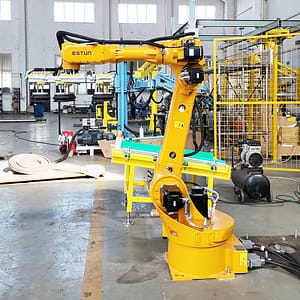
palletizing robot
Cartesian robots move along defined linear axes and are suitable for applications requiring predictable, repeatable movement between fixed positions.
They can be configured for individual machines or integrated into larger automated production systems. Their working range can be adjusted according to the machine layout and transfer distance.
For manufacturers handling relatively standardized workpieces, a Cartesian loading system can provide a straightforward approach to automating repetitive pick-and-place operations.

CNC machining is one of the most common applications for automated machine tending.
The robot transfers raw components into a machine fixture and removes finished parts after machining. Depending on the process, the system may also support part orientation, intermediate inspection, and transfer to another machine.
For factories operating multiple machining centers, a gantry system can be designed to serve several loading positions within a shared working area.
Laser cutting operations often require raw sheets, tubes, or profiles to be loaded accurately before processing.
An integrated loading system can collect material from a storage rack, transfer it to the machine, and remove finished products after cutting. Specialized grippers are selected according to the material dimensions, shape, surface condition, and weight.
Tongli’s existing laser tube cutting machine loading and unloading production line content describes a coordinated system incorporating a gantry manipulator, customized fixtures, feeding equipment, and control interfaces.
This type of integration helps connect raw material storage, machine processing, and finished-part collection into a continuous workflow.
Stamping and forming processes frequently involve repetitive transfer between feeding positions, presses, and collection areas.
A machine loading robot can be designed to handle workpieces according to the press cycle and required transfer path. Because these applications may involve hazardous machine movements, the complete cell must include appropriate safeguarding and safety interlocks.
In injection molding, robots can remove finished parts from molds and transfer them to conveyors, inspection stations, or secondary processing equipment.
The tooling must be compatible with the component geometry and surface requirements, particularly when parts are lightweight, delicate, or prone to deformation.
Some workpieces pass through several machining or processing operations before reaching the finished-product stage.
A coordinated handling system can transfer components between machines, intermediate fixtures, and inspection stations. This reduces the need for manual transportation and helps establish a more organized production sequence.
Selecting a machine loading robot requires more than checking its maximum payload. The system must match the complete production process.
Determine the weight and dimensions of the raw and finished workpieces. Include the mass of the gripper or fixture when evaluating the required robot payload.
If different product specifications are processed on the same line, identify the full range of sizes and weights that the system must handle.
The required placement accuracy depends on the machine fixture, workpiece geometry, and manufacturing tolerance.
Some applications require only reliable transfer to a loading station, while others require precise positioning into a machining fixture.
The robot, gripper, fixture, sensors, and machine interface should be evaluated together to achieve the required loading consistency.
The handling cycle must fit within the production process.
Important factors include the pickup distance, robot travel speed, gripping time, machine door operation, fixture loading, unloading, and workpiece release.
Manufacturers should identify the target production rate and determine whether the robot can complete the required movements without creating a new bottleneck.
A dedicated robot may be suitable for a single machine with a stable, high-volume workload.
When several machines are arranged along one production line, a gantry robot or shared handling system may provide an alternative. However, the design must account for machine cycle differences, simultaneous handling requirements, and possible conflicts between loading requests.
The available floor space, ceiling height, machine access points, material storage positions, and operator work areas all influence the robot configuration.
A gantry system can make use of overhead space, while a column-based solution may suit a compact cell. Maintenance access and safety provisions should be included in the initial layout.
The end effector is responsible for securely handling the workpiece throughout the loading cycle.
Different materials and component geometries require different gripping methods.
Mechanical grippers can be suitable for rigid components with accessible gripping surfaces. Vacuum tooling may be appropriate for compatible sheet materials or products with suitable surfaces. Specialized fixtures may be necessary for cylindrical parts, irregular components, or workpieces that require a specific orientation.
The gripper design should consider workpiece weight, center of gravity, surface finish, deformation risk, and the possibility of chips or coolant affecting the gripping area.
For applications involving multiple workpiece types, interchangeable tooling or adjustable gripping mechanisms may help increase flexibility.
A machine loading robot delivers the greatest value when it communicates effectively with the machine it serves.
A typical automated machine tending workflow includes the following stages:
The exact sequence varies according to the production equipment and control architecture.
Integration may involve PLC communication, position sensors, machine-ready signals, door control, fixture confirmation, fault detection, and safety interlocks.
For existing factories, the interface between the robot and the original machine should be assessed early to identify any necessary hardware modifications or control-system upgrades.
Standard robotic configurations may work well when workpieces, machine positions, and production cycles are consistent. However, real manufacturing environments often include special requirements.
Customized machine loading robots can be designed around:
A customized gantry manipulator, for example, can be engineered to match the positions of multiple machines and the required material transfer path.
The goal is to create a complete machine tending solution that fits the actual manufacturing process rather than adapting the process unnecessarily to a standard machine.
Machine loading robots help manufacturers automate the repetitive movement of workpieces into and out of production equipment. By coordinating material handling with machine cycles, they can improve workflow consistency, reduce manual handling, and support more efficient use of production resources.
The most suitable solution depends on workpiece characteristics, loading accuracy, payload, cycle time, machine arrangement, and integration requirements. Gantry robots can be considered for long travel distances and multi-station handling, while column-based and Cartesian systems may suit more localized applications.
For manufacturers planning to automate CNC machining, laser cutting, stamping, or other industrial processes, a carefully designed machine loading system provides a practical foundation for building a more connected production line.
