
Carton unloading is a common but labor-intensive operation in manufacturing plants, warehouses, distribution centers, and logistics facilities. When cartons arrive on pallets, operators traditionally need to unload them manually before sending them to conveyors, production equipment, storage systems, or order fulfillment areas.
A carton depalletizer automates this process and creates a more efficient connection between palletized inbound goods and downstream operations.
With robotic handling, intelligent control, and optional vision technology, automated carton depalletizing systems can handle repetitive unloading tasks while providing flexibility for different carton sizes and pallet configurations.
Manual depalletizing can become a bottleneck when production volumes increase. Workers may need to repeatedly lift cartons from different pallet heights and transfer them to conveyors.
This type of operation is not only repetitive but can also create ergonomic challenges.
Automation changes the process by allowing a robot or automated handling system to perform carton picking continuously. The system can be designed around the required carton weight, dimensions, pallet height, production rate, and downstream conveyor layout.
Robotic depalletizing is now used across logistics, retail, consumer goods, manufacturing, and healthcare-related material handling applications.
A robotic carton depalletizer uses a programmable robot to remove cartons from pallets and place them onto a conveyor or another predefined location.
The basic system may include:
The configuration depends on the application.
For simple single-SKU pallet loads, the robot may follow a predefined pallet pattern. For mixed cartons or changing pallet arrangements, a vision system can identify the position and orientation of individual cartons before the robot performs the pick.
This allows the system to handle more complex depalletizing tasks.
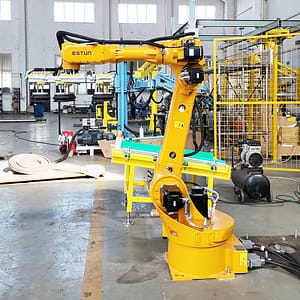
palletizing robot
The workflow can be divided into several stages.
A loaded pallet enters the depalletizing station through a pallet conveyor or pallet handling system.
The pallet is positioned within the robot’s working area.
Sensors determine the pallet position and carton configuration.
For advanced applications, a 3D vision system can scan the pallet and identify carton locations and dimensions.
The robot selects a suitable carton according to the programmed sequence.
A vacuum gripper is often suitable for many carton-handling applications, while mechanical or customized grippers can be selected for cartons with special surfaces or structural characteristics.
After picking the carton, the robot moves it to the target conveyor.
The motion path can be optimized to reduce unnecessary movement and maintain consistent cycle times.
The carton is transferred to a conveyor, sorting system, production line, warehouse system, inspection station, or other downstream equipment.
Some automated depalletizing solutions are specifically designed to feed sorting conveyors or automated storage systems.
Once all cartons have been removed, the empty pallet can be automatically discharged and replaced with a new pallet.
The result is a continuous automated carton unloading process.
One of the biggest advantages of robotic depalletizing is flexibility.
Traditional automatic systems often work best when carton dimensions and pallet patterns remain consistent. However, modern warehouses frequently deal with multiple SKUs.
A vision-guided carton depalletizer machine can identify different carton positions and adapt the robot’s picking sequence.
For example, an automated system can be designed to handle cartons with different dimensions, weights, colors, or pallet patterns. Advanced robotic depalletizing solutions are capable of supporting single-case, mixed-case, and complex pallet configurations.
This makes robotic systems particularly valuable for distribution centers and high-mix manufacturing environments.
The differences between automated and manual carton unloading are significant.
Manual unloading depends heavily on available labor and operator consistency. Productivity can also vary throughout a shift.
A carton depalletizing robot, by comparison, performs the same programmed process repeatedly. It can maintain a predictable material flow and reduce the amount of repetitive lifting required from workers.
Automation can also make production planning easier because the depalletizing process can be synchronized with conveyors and downstream equipment.
Before purchasing an automated carton depalletizing system, companies should evaluate several technical requirements.
The robot and gripper must be capable of safely handling the complete range of carton specifications.
Pallet size and maximum stack height affect robot reach, workstation dimensions, and equipment configuration.
The target cartons per minute or cartons per hour determines the required robot performance and system architecture.
Some robotic depalletizing applications can achieve high cycle rates, but actual performance depends on carton size, pallet pattern, robot configuration, gripper design, and required movement distance.
Vacuum gripping performance can vary depending on carton material, surface condition, dust, coatings, and packaging design.
Therefore, gripper selection should be evaluated using actual product samples whenever possible.
If every pallet follows the same pattern, a relatively simple control strategy may be sufficient.
For mixed-SKU pallets, machine vision and more advanced robot programming may be required.
The depalletizer should communicate effectively with conveyors, PLCs, pallet handling systems, production equipment, WMS/WCS platforms, and safety systems where applicable.
A well-integrated system can turn carton unloading from an isolated machine into part of a complete automated material handling workflow.
A carton depalletizer can be applied in many industries, including:
For example, distribution centers can use robotic depalletizers to break down incoming pallets and feed cartons into sortation or storage systems. Manufacturing facilities can use them to automatically supply cartons to production and packaging processes.
A carton depalletizer works best when it is designed as part of the overall material flow.
A complete solution may include pallet conveyors, pallet positioning systems, robotic or gantry handling equipment, carton conveyors, vision systems, safety fencing, control cabinets, and communication interfaces.
Depending on the factory layout, the system can also be connected with automated storage, sorting, inspection, labeling, or palletizing equipment.
The objective is not simply to replace one manual operation. The goal is to create a continuous and reliable flow from receiving to the next production or logistics process.
A carton depalletizer is an effective automation solution for companies that need to unload palletized cartons efficiently and consistently.
By combining robotic handling, customized grippers, conveyors, intelligent controls, and optional machine vision, manufacturers and logistics operators can automate carton unloading while reducing repetitive manual handling.
For facilities handling high carton volumes or multiple SKUs, a robotic carton depalletizing system can provide the flexibility needed to support modern automated material handling.
As automation continues to expand across manufacturing and logistics, carton depalletizers will become an increasingly important component of intelligent pallet handling and warehouse automation systems.
